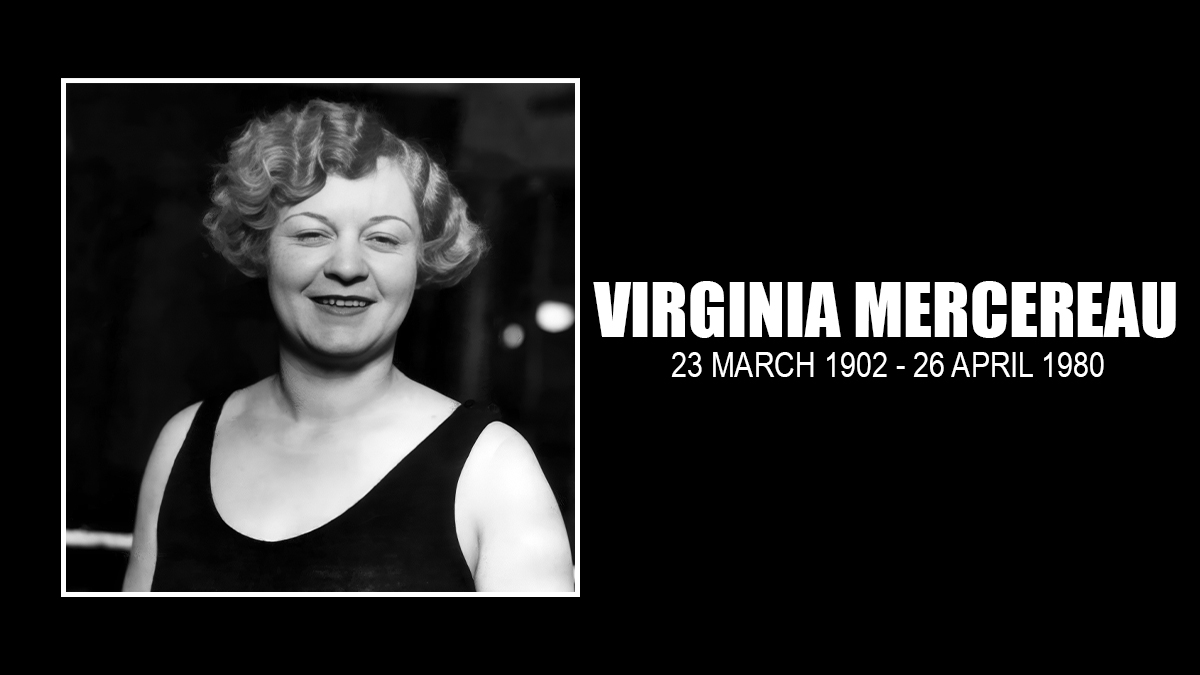
There are those whom the fates look favorably upon. The people who stroll through life blessed with love, happiness, and success. Marie Diderrich was one such person, enjoying a quiet, happy life in Wisconsin as a clerk and part-time athlete on the company basketball team. But success and greatness are two different things – sometimes you need a little nudge to jump from loved to beloved.
She was looking for a way out of her 9-to-5 Milwaukee life but needed a helping hand, and she found both in an unlikely source – boxing royalty looking to jump into promotion. But what happens when the gifts from the gods turn out to be tainted? If you are Marie Diderrich, you put your head down, barrel on, and become one of wrestling’s lost stars: Virginia Mercereau, women’s wrestling champion of the world.
This is the story of a young girl from Wisconsin who dared to dream big and found success in every endeavor she dared. This is the story of Virginia Mercereau, champion, hero, star, and survivor.
Part 1: The Rise (and Fall) of Virginia Mercerau
While the universe had great things in mind for young Marie, you wouldn’t have guessed it from her upbringing. Born Marie Nielen Diderrich on March 23, 1902, in the small city of Appleton, Wisconsin – nestled on the north shore of Lake Winnebago and not too far from Green Bay – Marie’s childhood and teen years were typical, uneventful, and completely unextraordinary.
Her father, William Diderrich, Sr., was a truck driver, and her mother, Harriette, was a homemaker, looking after the family’s three children, also including a sister, Jean (born in 1919), and an older brother, Harry, born a year before Marie, in 1901. And while both parents were German by birth, the upbringing of the children was thoroughly American. Marie was a popular student at Appleton High School who excelled in sports, and there were hints about the colorful future ahead.
“I’ve liked sports since I was young,” Diderrich told the Greensboro Record in 1924. “I was always something of a tomboy as I played with the boys as a little girl. The other girls wouldn’t play with me; I guess I was too rough.”
Life for the young woman continued to evolve in a typical manner after high school, with Marie moving to Milwaukee and working as a clerk (listed as a stenographer) in a downtown department store. Life in the city proved pleasing – especially when she joined the store’s women’s basketball team. She proved herself a fast, strong forward, eventually graduating to play for the semi-pro Milwaukee Five, as she told the local papers soon after her sudden rise.
“It’s not necessary for every young woman to become a wrestler, but anyone interested in physical development should take up that branch of sport,” Diderrich told the Milwaukee Sentinel on November 15, 1923.
“From my days in Appleton, I have been fond of athletics, and it was not so many years ago that I was playing forward on a Milwaukee star basketball team. I had the luck to make good and won a place on the Milwaukee Five, one of the fastest semi-pro teams in the west.
“Wrestling, a part of our training exercises, appealed to me, and I went for it, eventually winning the western championship. Now I’m going to take the world’s title back to good old Milwaukee,” she concluded.
Just how – and when – Diderrich turned to pro wrestling is unknown, with the only note of her entry into the business coming from a party announcement in the Appleton Post Crescent. The party, hosted by her brother at his home at 300 South River Street, just down the street from the family home, provided a rousing send-off for young Marie, who was apparently heading to Boston – Paul Bowser territory – for a meeting with the “eastern champ” and the Marie going by a new name, Virginia Mercerau. Even more confusing, she claimed a title – either the “lady wrestling champion of the West” or of the United States.
How did all this success spring up from seemingly nowhere? It was all thanks to a man who would provide pivotal not just in the career of Virginia Mercerau but the life of Marie Diderrich, too – Al Ketchel.
Prince of Ring
So, who the hell is Al Ketchel?
Well, essentially, he was boxing royalty. Albert was the brother of the famed Stanley Ketchel, the “Michigan Assassin” and former middleweight champion of the world. Stanley had an impressive record of 53 wins in his career, with 50 coming by way of knockout.
“Stanley Ketchel was one of the all-time greats,” said historian and author Bert Randolph Sugar. “At the turn of the last century, he was probably the equal of every fighter of that era, except Jack Johnson, and probably the equal of all athletes in popularity, except for (baseball players) Ty Cobb and Honus Wagner. That’s how big he was.”
With that power and success, Stanley Ketchel became very wealthy, purchasing a farmstead in rural Missouri – and it was on that farm, he was murdered in cold blood on October 15, 1910, presumably over a love tryst.
Al, for his part, was no pushover. A prominent lightweight fighter, Al Ketchel won the Connecticut state title numerous times and was a popular draw in his adopted Bridgeport, Connecticut, throughout the 1910s. This success, combined with his late brother’s estate, gave Al Ketchel a potent mix of reputation, connections – and cold, hard cash.
Ketchel was brash, handsome, charming, and mired with many of the vices you’d expect from a young, rich fighter. Ketchel liked two things in particular: fast horses and equally fast women. A playboy at heart, the younger Ketchel owned several thoroughbreds, which he liked to watch race in South Florida as he lived life to the fullest.
But why was a star boxer turning towards the management of wrestlers – and a woman wrestler at that?
There are some reasons. First, boxers can’t box forever. Time is the unified, undefeated champion in the ring, and, at 32, Ketchel was old. Finding his next path and attaching himself to a unique act could help open doors that his boxing connections couldn’t.
An October 27, 1919, edition of the Bridgeport Times & Evening Farmer saw Ketchel’s new manager, Benny Murphy, candidly discuss the prospects of the aging fighter:
“Al has placed himself under my management again; I am sure he is 50 percent. The boxer he was several years back, he can make good with the present crop of lightweights,” he told the paper, adding that his fighter was scheduled for two grueling matches to help establish his place back on the pugilistic perch. “This will prove to the Bridgeport fans that Ketchel is still a card throughout New England.”
But even if his manager had faith, it was clear that Al Ketchel’s in-ring days were numbered. And, like his brother, it would only be natural for the aging Al to try his hand at promotions.
Since his family held property in the Midwest, it’s not illogical that a spontaneous gym meeting between a pugilist and a basketball might occur. Adding more plausibility, Marie had originally hoped to be a boxer herself, but as she noted, “I got hit on the nose and didn’t like that, so I gave boxing up.”
The second reason Ketchel managed Mercerau was revealed when the two were first introduced in the same party notice: they were married. “Al Ketchel, brother of the Great Stanley,” was how the local press noted his arrival and the business nature of their relationship.
Coming for Cora
A confusing aspect of Mercerau’s early career is when and where it started. We are left with a mystery, wondering how a wrestling novice could quickly make the jump to the pros – and attain a claim for any title, let alone the “world” or “western” belts. What is for certain, though, was that by the fall of 1923, Mercerau was in full charge and had her eyes set on the reigning women’s champion (and a women’s wrestling hall-of-famer) Cora Livingston. While huge swathes of Virginia Mercerau’s early career are likely lost to time, names of some of the women she defeated on her rise to the women’s crown included Hazel Kinnard, May Kelly, and another name she would have to tackle to prove her credentials to Livingston: Bobbi Miller.
While the arrival of a contender to Livingston’s throne was a surprise, the people of Boston quickly warmed to Mercerau, the new foe. The Milwaukee Sentinel noted, “New Englanders, skeptical at first of the claims of this quiet, unassuming Wisconsin girl, now appreciate her remarkable work.”
The Bostonians liked Mercerau’s feminine nature – starkly contrasting Bobbi Miller’s more masculine nature. She wore tailored, frilly clothes and sported an aviator’s cap to protect her ears from cauliflower. She was friendly, approachable, engaging – and tough. Also, she was a technically skilled wrestler who wasn’t afraid to use her five-foot-six, 160-pound frame to her advantage. One of her favored moves was a vicious headlock, which she claimed she had picked up from another Wisconsin native – Ed “Strangler” Lewis.
Part of that appreciation came from a victory against Bobbi Miller on a Paul Bowser card at the Grand Opera House in Boston on November 17, 1924. But now the “lady champion of the west” was set to tangle with the eastern champion – the legendary Cora Livingston.
The long-awaited showdown with Livingstone finally occurred on Thursday, November 23, 1923. But almost as soon as it began, it ended.
According to the Boston Globe, the match ended in just 10 minutes, with Mercereau losing the fall to a hip toss. But the story appears murkier than a simple pinfall. According to Ketchel and Mercereau, Livingstone bolted, intimidated by her younger rival. Instead of splitting a fall a piece and angling for a third-fall draw, Livingstone won the first fall and simply never returned to the ring, her husband later declaring that the bout was always one fall only.
Whatever the real circumstances were is impossible to know – especially since the coverage in the press was minimal. But whatever the true result, the outcome was the same: Cora Livingstone retained her claim to the world women’s championship, and Mercereau was now staking her claim as middleweight women’s champion.
Virginia Mercerau, Wrestling Attraction
If the sketchy circumstances of the Livingston bout were designed to deter Ketchel and Mercereau, it backfired. Instead, the couple doubled down and pushed ahead with promotional plans in an unusual spot: Norfolk, Virginia.
The Portsmouth Star of January 11, 1924, announced an exciting return of wrestling to the area, with Ketchel, a “well-known wrestling promoter,” attempting to reinvigorate the local scene. The first card, held on January 14 at Pickwick Hall, featured a main event of Eddie Spencer of Omaha versus Martin Ludecke, a German middleweight and Jack Curley grappler who was currently claiming the championship of Central America. Mercerau, supposedly his star, was sidelined, only being introduced to the crowd at ringside.
Despite the best attempts of Ketchel, the Virginia experiment was a disaster. Worse, locally, it was difficult – if not impossible – to get Mercerau, an opponent that she was relegated to guest referee positions or simply announced to the crowd as a notable dignitary. Ketchel’s hair-brained promotional skills had sidelined his wife, the very person he was theoretically there to help.
That’s not to say she didn’t wrestle – just that records are scant for several of the supposed bouts. The Greensboro Record, in Greensboro, North Carolina, noted on February 18 that Ketchel had sent a wire noting that Mercerau would be heading to the city and that she had recently defeated a “Sailor Beaufort, champion of the naval base, Norfolk.” In fact, her display against Sailor Beaufort was so strong that she left the seaman with fractured ribs from her devastating body vice hold.
The Danville, Virginia, press is equally gracious in stating that Mercerau had “wrestled some twenty male grapplers” and noting some of Mercerau’s recent opponents, Joe Shimkus and star grappler John Kilonis of Manchester, New Hampshire. However, when (or if) these bouts occurred is unknown.
But again, Mercerau and Ketchel struggled to find opponents south of the Mason-Dixon line. Her much-hyped appearance in Greensboro was an open challenge. Fortunately, travel issues got in the way in Roanoke, and Mercerau could not make the date, with her debut pushed back a week.
There were bouts, including one against “The Terrible Swede” Jack Sendsten (a 30-minute draw in which the Swede was a last-minute replacement for Teddy Betz, a Greek middleweight who did show the date), with Mercerau being heralded as a draw with the local crowd thanks to an attendance of some 600.
Even Sendsten approved of Mercerau’s credentials, stating in one of those funny accents that press people love: “I hane vera much surprised; you har seen me wrestle before and I haf win mosta my match. I bane surprise a woman beat me.”
The Betz no-show soon became her first real angle, with the cocky Greek stating that he could “throw the woman every five minutes,” though he was proven wrong with a 15-minute draw on March 6, 1924, the best he could muster against Mercerau.
As she ran out of opponents, North Carolina promoters Woodell and Huffins sought to arrange a rematch between Livingston and Mercerau, this time to a finish. Unsurprisingly, however, Livingston, who clearly thought she had finished Mercerau some six months previous, declined. But this only helped to reinforce the myth of the title victory in Boston.
A Wager Worth Fighting for
Around this time, Mercerau began offering a standing wager, backed by Ketchel and (later) advertised by the popular Police Gazette tabloid.
The standing offer stated that any man in the United States, up to 160 pounds, would win $150 if they could throw Mercerau in 15 minutes. This offer only applied to the first fall, and there would be no cash rewards for throws after that 15-minute period elapsed – a bit like the old television titles of yesteryear.
When the wrestler’s weight was slightly over Mercerau’s, amendments would be made to the purse. For example, in a clash with George Volkert in Madison on July 13, 1925, the pot was reduced to $100, given his 175-pound weight versus Mercerau’s 160 pounds.
While the concept of a $150 bounty might sound quaint, it was a decent chunk of change in 1925 (valued around USD $2,500 or so in modern monies). Additionally, it helped add an interesting wrinkle to the Mercerau character. Local wrestlers and international stars would line up in this interactive element to prove they were tougher than a girl.
Barnstormers
The middle part of 1924 saw the couple tour the Midwest (and, supposedly, the Pacific Northwest), with Mercerau taking on numerous intergender challengers. One opponent we can pinpoint is Frank Martin, a local grappler whom she lost to on May 13, 1924, in Sturgeon Bay, Wisconsin. Mercerau had more than held her own, however, lasting 24 minutes in the first and 14 in the second and final fall. Similarly, Joe McGee, a Shellsburg, Wisconsin heavyweight, took two falls from Mercerau on August 20, 1924 – but only after the 15 minutes had elapsed.
Another name that relished the challenge of facing Mercerau was Manjiro Matsuda, a Japanese-born Jujitsu and professional wrestler and holder of the World Middleweight Championship, who also defeated Mercerau but failed to gain the wager, taking 23 minutes for the first and 13 minutes for the second fall.
Matches like the Matsuda contest were supposed to be the new pinnacle of Mercerau’s career, capturing headlines across her home state and showcasing her impressive success to friends and family. The tough slog of 1924 was nearly over and bearing fruit.
But the trajectory of Mercerau’s career changed abruptly on Tuesday, September 2, 1924 — and not just her career but her entire life. It was on that day the shoe finally dropped, and Al Ketchel’s shortcomings as a manager, publicist, and husband were laid bare.
The Champ & Her Chump
There’s a great bit in the Futurama episode “A Leela of Her Own” where Leela begs to be allowed to pitch in a blurnsball game, hoping to become the first female player in the sport’s history. She mentions to the New New York Mets manager that she learned from Hank Aaron (Hank Aaron XXIV, to be precise), to which the manager replies, “You were trained by the Hank Aaron?!” Leela’s retort, “I was trained by a Hank Aaron,” would be apropos for this story because, you see, Marie Diderrich had married an Al Ketchel – and not the real deal.
Marie, her family, and seemingly all experts from the Midwest to the Atlantic seaboard had accepted Mercerau’s manager at face value. It provided her access she might not otherwise have had. It got her into Boston and paired her against the biggest women’s star of the period, Cora Livingston. But it had destroyed her feeling of innocence and tarnished her sterling reputation amongst the people of Appleton.
So, who did she marry anyway? That’s difficult to say because newspaper records for “Leroy Bringham,” the name the police provided, are scant in Wisconsin – where he was wanted for larceny and grand theft auto. Bringham, a local conman, had purchased an Overland sedan from a dealership in Milwaukee in 1922 but failed to make payments and fled the state with the card in 1922.
Under his “Ketchel” alias, Bringham was finally captured on the evening of Mercereau’s match with Joe Parelli, a local middleweight champion of some 158 pounds at the Manitowoc Veterans of Foreign Wars Hall. Mercerau was defeated in straight falls, but the first fall had taken 38 minutes, meaning she retained her unbeaten streak.
The phony Ketchel had been traveling through Appleton before being spotted on College Avenue, driving another vehicle. Detective Ryan, spotting the now fleeing Bringham, jumped onto the car’s running board and steered it towards the curb – stopping it and the criminal. The conman spent the night in jail, while Marie returned home to a community willing to close ranks to protect its own.
The Fall of Virginia Mercereau
The marriage (if it existed) was declared dissolved, and the managerial contract was torn up. Diderrich was devastated but attempted to soldier on, hitching her wagon to the management of John “Doc” Krone, Chicago’s longest-tenured promoter, and announcing an eventual move to the Windy City.
But the move never seems to have occurred. While Krone made efforts to publicize the now Police Gazette-backed purse, Mercerau faded from public view – the prospect of upcoming matches being floated but never finalized.
At the same time, she found herself with a new, in-state female rival in the form of Nellie Downs from Eau Claire. While Downs was only 140 pounds, some 20 less than Mercerau, she declared herself willing to meet a woman of any size while simultaneously billing herself as the very impressive sounding “lady champion all-around athlete.”
Life can come at you fast. And when it hits you, smash in the face, it’s tough to know how you’ll react. Faced with a fraudulent marriage and a new, young upstart, Marie Diderrich retreated to the safety of her former life, free from conmen, double-crosses, and meager existence.
But neither Marie Diderrich nor Virginia Mercerau was defeated – she just needed time to dust herself off.
The year 1924 had been disastrous for both Marie Didderich and Virginia Mercereau – the ring name of the woman who rose from obscurity to stake her claim to the women’s middleweight wrestling championship of the world. If she had experienced career highs, they were outweighed by the calamitous ruin of her relationship with a man she thought was a boxing star – and her husband – but was really just a two-bit conman from down the block.
But the pain of 1924 and 1925 only served to drive the ambitions of a young woman left for junk on the scrap heap of the wrestling business. Marie Didderich was down, but she refused to be counted down. This is the second part of the story of a young girl from Wisconsin who dared to dream big and found success in every endeavor she dared. This is the final chapter in the story of Virginia Mercereau, champion, hero, star, and survivor.
Part 2: Virginia Strikes Back
The years 1925 and 1926 represent the dark ages for fans of Virginia Mercereau. There are no records of the activities of Marie Diderrich for the majority of 1925 or the entirety of 1926, indicating that she had likely taken time off from wrestling to return to normal life in Milwaukee – full of 9-5 jobs, errands, and lazy Sundays, but mostly bare of conman and other n’er-do-wells.
Only in February of 1927 did the once-dominant champion reappear with a big statement of intent – she was moving to Chicago. Marie Diderrich may have dropped the first fall but would not be beaten.
Back In the Big Time
Mercereau had briefly dipped her toes in the water of the big city wrestling with Doc Krone. But her return in 1927 is a defiant answer to anyone who may have remembered her embarrassing marriage and manager fiasco of 1924.
Diderrich reappears in the records in February of 1927, basing herself at Kid Howard’s Gym in Downtown Chicago, training with Ed (sometimes “Ad”) Herman, a middleweight contender. The venue was a popular training ground for pugilists and wrestlers alike and was a great place to build a reputation – something she immediately did.
On March 11, 1927, Virginia Mercereau added another title to her already impressive list of accolades – hero. A fire ripped through the five-story building downtown that hosted the gym, sending wrestlers, boxers, trainers, and other civilians screaming into the street – some half-naked. Some 300 guests at the next-door theatre rushed into the street to survey the scene when Kid Howard and Virginia Mercereau ran into the building, saving a young girl (possibly her sister) who had been overcome by smoke.
The story made the national press, and suddenly, Virginia Mercereau was back in the zeitgeist.
The Wager Returns
With a return to the ring, Mercereau once again staked her belief that no man of her size could throw her within a set time limit. Her stake was no longer a measly $150 bounty, replaced with a hefty purse of $1,000 (nearly $18,000 in today’s currency – now that’s foldin’ money). But the improved stakes required a bigger task – contestants were required to pin Mercereau for six seconds within a 15-minute time limit.
Mercereau’s first match on her comeback trail was against Soldier Mack on April 26, 1927, at the Appleton Guard Armory in Appleton, Wisconsin. Soldier Mack was Harry McKinley, a former soldier turned grappler who appears sparingly across Midwest wrestling cards in the 1920s and ’30s – the pair serving as the undercard to Karl Pozella and Hassan Hamey.
But almost as soon as Mercereau reemerged, so did the challenges from rivals. The first to issue a challenge was Teddy Meyers, originally of Youngstown, Ohio. Meyers (real name Zelle Wiseman) was an up-and-coming grappler who knew Mercereau was scheduled to arrive in Evansville, Indiana, to face a yet-to-be-found male competitor but who instead threw her name in the hat instead.
Mercereau accepted, and the match occurred on June 13, 1927, at the Soldiers & Sailors Memorial Coliseum in Evansville, Indiana. The bout – which shared the undercard of a Hans Bauer-Nick Valkoff main event with another former Mercereau victim, Soldier Mack, and George Walker – saw Mercereau decisively defeat Meyers in just 24 minutes.
Itinerant
Wrestling in the late ’20s had already begun the slow processes of coalition towards crude proto-territories, with the Boston stronghold of Paul Bowser and that of his Southern Californian associate, Lou Daro, perhaps the best examples.
Still, barnstorming was the norm for more than a fair few grapplers, and Mercereau was no different. So unique was her appeal that local promoters often balked when presented with an opportunity to book the women’s champion lest the situation develop into a farce, a riot, or a picketed affair by the local busybodies.
Because of this, Mercereau was forced to adopt a far more elaborate setup to promote the few bouts she could book. After leaving Indiana, for instance, Mercereau’s camp moved from Kid Howard’s Gym in Chicago to the Hermitage in Ogden, Utah, ahead of her next match-up in that city. Because the peculiarness of a women’s champion – especially one out in the rugged Wasatch Front – was still so new, much of the salesmanship for the bouts came from the sparring sessions between Mercereau and Ad Herman, her training partner.
As was the case in Chicago, Mercereau would train and spar at her camp with locals getting a chance to see a real-life superhero in the flesh.
Her opponent in the Beehive State was Jack Reed, a Danish-born wrestler who appeared on a smattering of cards in the late 1920s and early ’30s.
Reed was no slouch, however – especially when you consider the company he kept. On November 5th, for instance, a wrestling exhibition was given by Jim Londos, Greek wrestling champion and Jack Reed in Ogden, to a crowd that included former governor and secretary of war George Henry Dern.
A Reliable Act
Fortunately, Mercereau at least found another partner, as the previous bout with Meyers was clearly part of a routine run for local associations. This time, the North Lake Park Association in Mansfield, Ohio, was lucky enough to get the hotly-anticipated contest between the women’s champion of the world (and defeater of Cora Livingston) and a young upstart looking to knock her off her perch.
Both women arrived in Mansfield on Thursday the 20th, Mercereau from Chicago and Meyers from Georgia. Local bureaucratic excitement was raised to such a fervor that both women were offered “the freedom of the city and other courtesies.”
The local coverage for the bout was impressive, including a fantastic “tale of the tape” that I’ve included below:
| Miss Mercereau | Miss Meyers | |
| 156 lbs. 5’ 6” 26 ⅛” 14 6 18 2 29” 41” 15” 9 ½ | Weight Height Arm Reach Upper Arm Wrist Chest Chest Expansion Waist Hips Calf Ankle | 144 lbs. 5’ 4” 26 ½” 13 7 31” 2 30” 44” 16 ⅓” 11” |
Interestingly, Mercereau, in declaring her confidence ahead of the match, stated that the two had first met a year ago, with a result similar to the Evansville clash – two falls in quick succession. This is likely just an attempt to provide greater provenance to the feud – and Meyers’ pursuit of Mercereau.
Meyers, for her part, was equally confident:
I am in better shape for my return match with Miss Mercereau, and I believe I will be the victor tomorrow. I have improved my technique and have gained considerably more experience since I last met Miss Mercereau.
– Miss Teddy Meyers, Mansfield News Journal, Mansfield, Ohio, October 20, 1927
The return match was hailed as a massive success by organizers of the North Lake Park Association. “Miss Virginia Mercereau, Chicagoan and world’s champion woman wrestler, successfully defended her title in a true slam-bang match at the Coliseum Friday night before some 1,000 customers,” read the copy from local sport’s ace “Keg.” Mercereau won the first and third falls against Meyers, taking the first in 23 minutes after applying her famed headlock (which she claimed to have picked up from Ed Lewis himself) and body scissors for the third fall.
For her part, Meyers won the second fall with a toe-hold, but it was the power of Mercereau that was just too much for Meyers to contend. The headlock, which scored the first fall, was a determining factor – weakening Meyers in the latter stages: “I thought she had broken my jaw,” she told the News Journal the next day. The news was also reported back home in Appleton – always proud of its former residents.
The routine was so effective that the women met in Atlanta in December. Local promoter John Contos had been promising local mat fans “something different” on the December 11th card at the City Auditorium, with Meyers – the local hero – and Mercereau the surprise.
Contos was so confident in the booking that he showed news clippings to back up his claim that “wherever Miss Mercereau had appeared, she had made a distinct hit with the fans, both by her skill and ability of disposing her opponents.” He also confirmed that he had held off booking the contest until getting advice from other promoters who had hosted Mercereau – finding a spotless resume.
The latest Meyers-Mercereau contest was on the undercard of a stacked card, including local favorite (and future promoter) Paul Jones (not that one), “Scotty” McDougal, Jim Browning, and Charlie Hanson. Again, Meyers was at an eight pounds disadvantage, but she thought her skills (and possibly an advance agreement) would finally see her through – it didn’t.
The Stage Beckons
Mercereau’s next appearance was back in Chicago as part of the Chicago Tribune’s Good Fellows show to entertain First World War veterans at the local Speedway Hospital. Mercereau was joined by Kid Howard, several amateur boxers, and an entertaining troupe to bring joy and distribute presents to the bedridden veterans. There were boxing bouts, music from the Chicago White Wings band, and plenty of vaudeville excitement from the pair of Si Jinks and Lillian Hartford.
The addition of vaudeville to the entertainment was fitting, and not just because vaudeville formed such an integral part of early 20th-century entertainment, but because it was another detour in the career of Marie Didderich/Virginia Mercereau.
This charity event is the first instance of Mercereau appearing in a vaudeville performance, but it wasn’t her last. Getting bookings was still an issue despite her renown. Sure, there were the bouts with Teddy Meyers, but as with Cora Livingston some four years prior, there was only so much juice to squeeze. The Meyers-Mercereau rivalry could still enjoy coverage, as the January 29, 1928, edition of the San Francisco Examiner attests, but only one woman could win – and that was the issue.
Meyers had followed a similar path to Mercereau, using her loss to launch her title claims – the heavyweight title in this case. As before, assigning yourself a weighted championship to avoid stepping on the toes of other female grapplers was effective – but the real draw was intergender matchups.
There were still matchups with men, such as a victory over Carley Peterson in Milwaukee in early December 1927 or against Howard Blazer on February 1, 1928. However, these events were sparse and often included no other wrestling. The Blazer match, for example, was the only match-up and was followed by a dance.
The issue was bookings – or, namely, the need for bookings she could obtain. Doc Krone tried, often in vain, to promote his star with engaging photos and copy designed to showcase the impressive skills (and record) of Mercereau.
But nothing seemed to work.
Golden Accordion Girl
So, what did Virginia Mercereau do? She picked up her accordion and kept right on going.
Finding bookings drying up, Mercereau turned to vaudeville to stay relevant. A musician in her youth, she found limited success as the “Golden Accordion Girl, Virginia Mercereau.” The act was a way to get bookings, keep her name in the public eye, and use the vaudeville stage to coax potential male opponents into the ring.
And it wasn’t a success. Sure, there were a handful of bookings here and there over the next year or so, but more was needed to make a go of it. And without demand, there was minimal income, requiring Marie Didderich to do a serious rethink.
More Than Just a Pretty Face
Despite the reduced bookings, Marie Didderich had no problems keeping the Virginia Mercereau name in the press. Part of it was down to her unique story and impressive skills, but some were down to her looks – and the attention they drew from “smooth operators.”
Despite her “unblemished” record, Mecrerau was still a young woman in Chicago – with all the catcalls that entailed. But Mercereau wasn’t one to take catcalls lightly – just ask George Duffy, a local guy who had his eye on the champ. On July 31, 1929, Duffy caught a glimpse of Miss Mercereau as she was window shopping.
According to the press, the incident went something like this:
“Waiting for a street car, baby?”
“I’m going shopping,” Mercereau replied.
“Can I go along,” he replied, thinking he was in with a shot.
“You not only can, but you will,” yelled Mercereau, followed by a right hook, a headlock, and a swift, firm blow between his shoulder blades.
Duffy was down, out, and later booked at the nearest station.
As he was being booked, he demurely asked Mercereau what her profession was – “Why, I’m claimant to the title of world’s middleweight woman wrestler,” was the reply. “Look up my record.”
All Duffy could muster as he was jailed was, “I wish I had.”
Exiting the Business
That career rethink, which came around 1930, was essentially the end of the career of Virginia Mercereau. Finding herself facing an insurmountable headwind in the wrestling business, Marie Didderich decided to drop out of wrestling and move into health and fitness.
Newark, Ohio, was her final destination, though it was erroneously reported as Newark, New Jersey. The mistake was understandable – after all, the women’s champ would always be in the biggest and brightest cities.
But this wasn’t Virginia Mercereau; this was Marie Didderich. Marie wasn’t the women’s champ – she was the manager of the John P. Glass Health Service.
While working with the company, she still found time to perform as the “Golden Accordion Girl,” Virginia Mercereau, usually for the annual Fall Fashion Show.
A Replacement Arises
But don’t worry. The Women’s World Middleweight Championship wasn’t abandoned – someone else just appropriated it. The culprit was one Mae Meyers of St. Paul, Minnesota. The February 9, 1936 edition of the Wisconsin State Journal notes that Miss Mae Meyers “defeated Miss Virginia Mercereau some time ago to win the women’s crown.”
According to the Capital Times in Madison, Wisconsin, on February 7, 1936, Mae Meyers – who was defending her hard-earned championship against the latest contender, Stella Brown – apparently “won the championship from Virginia Mercereau by overcoming a 30 pound weight advantage and winning the match in straight falls before a capacity crowd in Seattle, Washington.”
I have found no evidence of this bout and doubt it ever occurred.
Why Seattle? I guess 1936 was a simpler time before the success of intercontinental airfare and the creation of international phantom title changes. Regardless of the particulars, Marie Didderich had left the business for good – she was born a generation too early.
In the next decade, women’s wrestling would gain a greater deal of acceptance and credibility – particularly on the back of talents like Mildred Burke, Clara Mortenson, and others. That credibility was made official with the sanctioning of the first “official” Women’s World Championship in 1937.
Happily Ever After
But while Marie was out of wrestling, she was just getting started living her happily ever after. She continued her successful role in healthcare for several years before upping sticks and heading west.
In 1943, Marie found love, marrying Edward Frisby, a Utah-born businessman in Los Angeles, before finally settling in the deserts of Southern California – namely the affluent Palm Springs community. There, Marie would turn from brutality to hospitality, opening a successful restaurant, the Watering Trough in nearby Cathedral City. The hangout was popular for its hamburgers, with the couple eventually cashing out sometime around 1963.
Marie (sometimes spelled Maree) spent her remaining years supporting her family’s artistic endeavors. Marie Frisby died on April 26, 1980, at her longtime residence in Palm Springs. Upon her passing, there was little discussion of her past life in basketball, wrestling, or vaudeville.
For a woman who experienced such a dramatic public humiliation in her professional and romantic life, Marie Didderich never let life get her down. From humble Midwestern beginnings, she let her gifts guide her and never surrendered – even when personal tragedies almost won.
While undoubtedly chaotic, her grace, humility, and take-no-shit attitude is apparent throughout. When a roadblock emerged, she took a designated detour – or created one for herself.
But it was those Midwestern values that kept her centered – and eventually helped steer her to a happily ever after – selling the best hamburgers under the Palm Springs sun. And throughout – until the very end – she was surrounded by her loving and devoted family.
The Legacy of Virginia Mercereau
Women’s wrestling has enjoyed a great surge in popularity in the 21st century, largely thanks to stars like Trish Stratus, Lita, Natalya Neidhart, and others. But the Attitude Era also brought the Fabulous Moolah and Mae Young, two stars of several previous generations, back to the fore.
And with that acquaintance sprang a more serious study of the history of women’s wrestling, with countless works in the ensuing decades. Beyond the WWE-produced autobiographies, there is the exceptional Sisterhood of the Squared Circle: The History and Rise of Women’s Wrestling by Pat Laprade and Dan Murphy, for example. Other historians have taken closer looks at influential stars, like John Cosper’s The Girl With The Iron Jaw: The Amazing Life of Mars Bennett. For those who prefer film to print, there’s the 2004 documentary Lipstick & Dynamite, Piss & Vinegar: The First Ladies of Wrestling.
I could wax poetically about the merits of these works and many others, but let me try to stay on track with this narrative.
While these efforts are undoubtedly commendable (and excellent), they are limited in their scope. Not because the researchers were lax but rather because there is always more to discover in the world of wrestling. Any attempt at a fully comprehensive account on the history of any facet of the wrestling business is doomed to failure because the compiler would die long before they could consult every resource and get every angle.
Even with Virginia Mercereau, there are many stories to be told of this remarkable woman. The fate of Leroy Bringham, AKA “Al Ketchel,” for example, is of particular interest. It’s likely local researchers can shed much more light on this facet of her story – one of the limitations of online newspaper archives.
So what is the legacy of Virginia Mercereau, middleweight women’s wrestling champion? Unfortunately, not much. Sure, there were a few “remember when” posts through the years and a 1972 television show in which she is mentioned, but the name Mercereau is effectively lost to time.
And that is a major shame. She was a woman ahead of her time – ten years to be precise. With the end of the 1930s came the rise of Mildred Burke, Mae Young, and other women grapplers who were allowed to star in their own right.
Gone were the days of “seedy” intergender matches, and in its place was sanctioned, sterile competition between two women. It’s in this period that Virginia Mercereau would have excelled, but she was born too soon.
But wrestling’s loss was life’s gain, with the spirit of Marie Diderrich proving insurmountable, regardless of the odds. No matter where she turned her attention, she succeeded. From basketball to wrestling to vaudeville and business, Diderrich never quit.
Her reward for that dogged determination was a life full of love. Upon her passing, scantly, a word was mentioned of her past life as world champion, but it didn’t matter. Even without the credit she deserves, there is only one word to describe Marie Diderrich, “Ketchel,” Frisby, Virginia Mercereau, or whatever name you prefer:
Remarkable.