Wrestling historian Dave Meltzer has lost more than a step or two in the last 10 or more years. Yes, his historical knowledge is unmatched in wrestling journalism. There is no doubt about that, but his opinions and reporting have a lot to be desired. From misrepresenting facts to being inaccurate about the situations he is reporting on, with no apologies or retractions, I might add, Meltzer’s legacy has certainly taken a beating. There is no masked man to blame either. Meltzer has done this to himself.
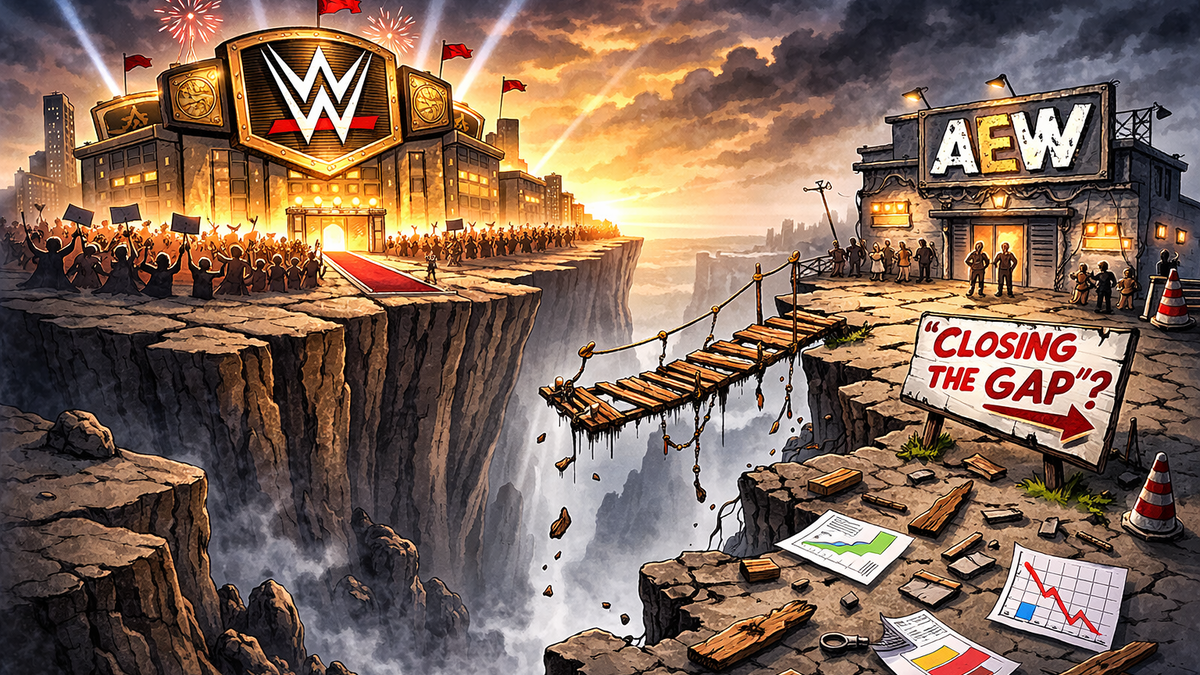
Meltzer spouted off recently about AEW “closing the gap” on the WWE. On an episode of Wrestling Observer Radio, he said:
“And I think in this one, they’re way, way ahead, but the gap is closing. Even though they’re still way ahead, the other guys are coming up. And all the little tricks—when they started coming up, or even before they started coming up—to try to put them in the dust, like putting those head-to-head shows, every time it backfired. AEW did a good number, and they always did a lower-than-usual number every single time.”
The phrase “the gap is closing” implies there is some kind of great progress or improvement toward equality, a balance between two things, that the disparity is shrinking in a meaningful way. When it comes to the differences on paper between the AEW and WWE, that simply isn’t true. Meltzer is playing fast and loose with the facts in the sense that he is doing what he always does, exaggerating slight improvements, hailing them as significant gains in an overly positive and idealistic way. Of course, he always accompanies these statements with caveats to give himself wiggle room to save face in case he is criticized. In this instance, he says: “they’re way, way ahead, but the gap is closing”. If the disparity is so wide, doesn’t that make the “closing the gap” remark very trivial or so inconsequential that it is not worth mentioning at all?
Now, let me be clear. I want ALL promotions to do well. If they are, the fans and the talent both win and nobody loses. With that out of the way, let’s examine Meltzer’s claim with evidence and numbers, as we all should know that opinions and personal perspectives are NOT facts. Meltzer is probably basing his “closing the gap” theory based feedback, comments in social media echo chambers and the fact that some of AEW’s numbers have improved…slightly, as of late.
Let’s check in with AEW.
But first…
We cannot and will not include the streaming statistics since Warner Bros. Discovery hasn’t felt confident in releasing them, so they are a moot point not worth discussing. The numbers could be great, they could be utter crap, but we don’t know. Based on my 25+ years covering the entertainment industry, I would say if the network is not willing to publicly disclose the numbers, the numbers themselves aren’t anything to crow about, or they certainly would be. That has been the mindset and the trend.
AEW Collision
Collision’s ratings have been around 350 ,000 on average, with the 18‑49 demo lower than previous years. Yes, there has been some improvement, but the growth is uneven, and Collision has not returned to 2023 levels. The numbers are fine for a weekend wrestling show, but the Collision trend is flat to sloping downward. Since its 2023 debut, AEW Collision’s ratings have dropped about 30–45% in 2024 compared to 2023, and another 10–25% in 2025 versus 2024. Early 2026 shows a modest 8% increase in total viewers compared to early 2025, though the key 18–49 demo remains well below its 2023 levels.
Is Collision “closing the gap” in a meaningful way? No.
Dynamite
Since its debut, Dynamite has lost viewers. When it started, the show often scored higher than 800,000 viewers, but in 2024, the number has dropped 30% and the key demo down 40%. In 2025, the show averaged 500,000 to 600,000 viewers with some lows near 398,000. In 2026, there has been a slight tick up of 5 to 8% in total viewers, but the 18–49 demo is either flat or slightly down. It is about 0 to 5% lower compared to the same period in 2025. So, while total viewers showed a bit of an increase, the demo has not rebounded significantly and remains well below the 2023 peak, still down about 40 to 45% from its highest 18–49 ratings.
Is Dynamite “closing the gap” in a meaningful way? Another, no.
Ticket Sales
2023 averaged about 5,812 tickets distributed per event, but by 2024, that dropped roughly 27% to about 4,259 per event. Total attendance across all AEW events fell from around 552,000 in 2023 to about 421,600 in 2024.
2025 shows very mixed data. PPVs and International events did far better than North American Dynamite and Collision tapings which averaged 1,000–3,000 tickets per event, distinctly down from previous years. From 2023 to 2024, AEW’s average distributed tickets per event dropped by about 25 to 30%. So, while attendance for TV tapings remains very soft their PPVs do well, truth be told.
Are ticket sales “closing the gap”? Not when compared to the WWE’s.
Here are the facts based on numbers, not personal perceptions or narratives.
AEW has established a solid base of dedicated fans that give the promotion decent cable TV numbers, PPV buys and international attendance figures. That fan base, though, is not growing. It has only declined since the start. Their overall viewer numbers have increased slightly recently, but not to the levels they have had before or those of the WWE. Their key demos are very troubling and remain well below what they used to be.
AEW’s average weekly attendance is down 25 to 30% since 2023. Only PPVs and international shows draw fairly decent crowds, comparatively, but nothing near WWE’s on a regular basis. While AEW has grown slightly in certain areas, it is still but a fraction of the WWE’s size. AEW has a dedicated and loyal fanbase, but WWE is massively ahead in any and all objective metrics.
Meltzer’s claim that “the gap is closing” is incredibly misleading, but it is the narrative his fans want to hear and rely on in the echo chambers he has established and participates in, and they don’t question those claims.
As to his comment:
“And all the little tricks—when they started coming up, or even before they started coming up—to try to put them in the dust, like putting those head-to-head shows, every time it backfired. AEW did a good number, and they always did a lower than usual number every single time.”
The statement “every time it backfired” and “AEW did a good number, and they always did a lower than usual number every single time” spoken as facts is misleading and overstated as well. Whether intentional or not, it has worked here and there.
Some examples of AEW and WWE going head-to-head, whether incidental or not:
- On November 17th, 2023, SmackDown was directly against Collision. WWE SmackDown had 2,206,000 viewers, 0.62 demo. Collision had AEW Collision: 270,000 viewers, 0.08 demo. Collision hit one of its lowest numbers ever.
- On September 6th, 2024, SmackDown was up against Collision again. SmackDown: 1,770,000 viewers, 0.45 demo and Collision: 157,000 viewers, 0.04 demo. Collision lost 60% of its demo audience week-to-week and had one of the lowest ratings in AEW Collision’s history.
- On July 6th, 2024: WWE Money in the Bank versus AEW Collision. Collision had 306,000 viewers, which was down from 422,000 the previous week. AEW dropped 27% when compared to a WWE PLE.
- On December 14, 2024, SNME went up against Collision, resulting in Collision having 246,000 total viewers and a 0.09 demo rating. This was Collision’s lowest viewership in its regular timeslot ever at the time.
In every case, Collision’s numbers are lower against WWE programming than the previous week, and these are just a few examples.
In journalism, trust is everything. If an audience cannot trust a news source, the facts they provide, the reporter loses all credibility. Reporting or even stating an opinion as fact without any evidence to back up those thoughts is just as bad and as troubling as misleading fans and readers. It is especially terrible when there is no masked man to blame.