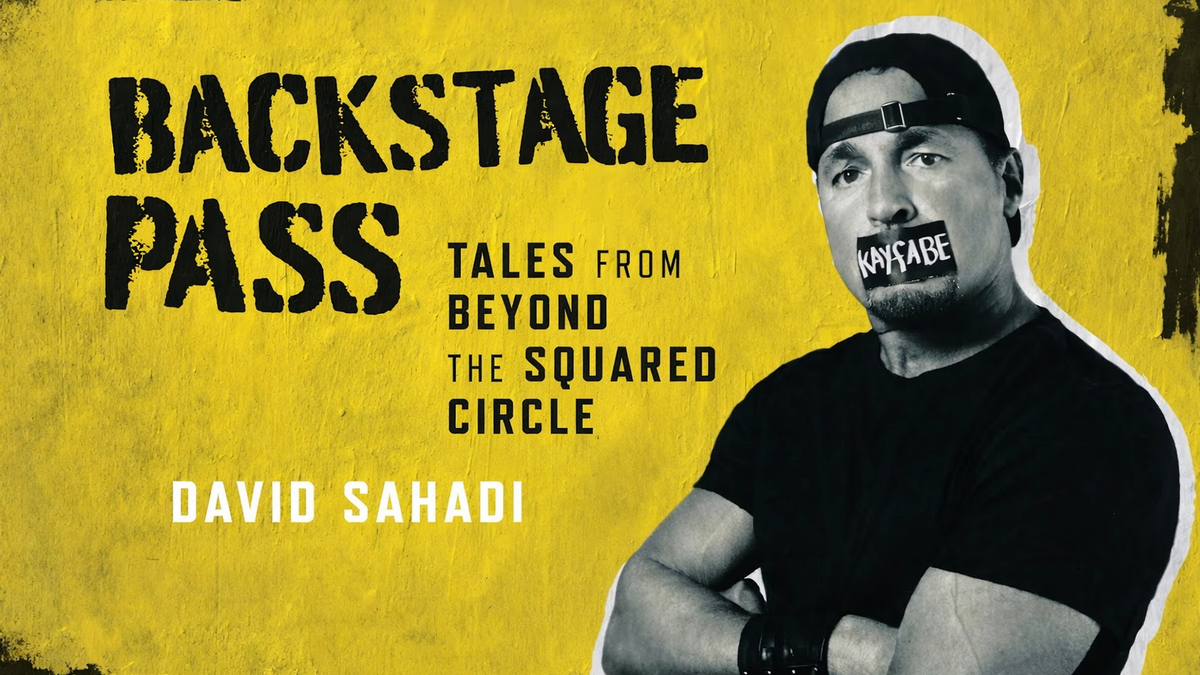
Many different people are credited when a pro wrestling event goes well: the wrestlers (obviously), the commentators, the referees, and the invisible powers-that-be that run things from behind the scenes. But there’s one group of people who, by and large, haven’t been given the same credit for their involvement in this endeavor: producers. For some people the very notion of producers makes them bristle, as it conjures up images of disconnected TV executives and other outsiders who see wrestling not as a unique form of entertainment but as just another product to format for broadcast. For David Sahadi, becoming a producer for WWE, TNA, and later MLW was a started off as a dream but also included fair share of nightmares.
These experiences are chronicled in his book Backstage Pass: Tales From Beyond The Squared Circle, published by Canada’s own ECW Press to be available for purchase March 10th. Though there have been many books that’ve covered the byzantine and Machiavellian world of professional wrestling, none have covered it from the perspective of a production member. This framing is truly unique as Sahadi’s career and life experiences give credence to the stories told by wrestlers whose claims of backstage politics have, in many cases, been delegitimized as further expressions of kayfabe or carny-talk.
Sahadi’s decision to join the then-WWF stems from frustrations working for NBC and the various unnamed corporate suits that make his life more difficult than it needed to be. There is a great degree of poetry in Sahadi’s work: not only from his passion as a writer and his right-brained creativity, but because his experiences mirror those to have entered wrestling before and after him through the pathway of pro-wrestling itself. Sahadi’s first major experience with a known executive is with Dick Ebersol who was a personal friend of Vince McMahon’s. Though Ebersol treated him with respect, his cronies did not. From the many stories to have emerged about Vince McMahon over the decades, this was largely true as well: Vince himself would treat people well but his stooges were another story.
Upon joining WWF/E, Sahadi achieves immense success, both personal and professional. McMahon gives him the trust and freedom to create commercials, vignettes, cold opens, and more, which Sahadi describes as Vince “giving me the wings I needed to fly”. Spurred by the desire to showcase his outside-the-box thinking and get back at the conservative and risk-averse executives from his former employer, Sahadi dives headfirst into the world of professional wrestling. The results speak volumes: Sahadi is credited with the launch of several famous videos including the cold open for the first episode of RAW, the famous opening video of Steve Austin walking through an industrial area as explosions went off around him, and WWF’s Superbowl ads.
In an interesting twist, the WWE Vault YouTube channel has recently begun releasing never-before-seen footage of various goings-on. This includes the following video showing behind-the-scenes footage of one of the company’s infamous Super Bowl ads. And the man responsible for writing, directing, and editing all of this, who can be seen in the video below directing Dwayne “The Rock” Johnson? David Sahadi.
But Sahadi wasn’t the only man responsible for ushering in this new era of creativity and success for the company. In his own words, he credits what would become known to the world as the Attitude Era to himself, Jim Johnston, Chris Chambers, and Kevin Dunn. That latter name proves to be an interesting point as the relationship between Sahadi and Dunn serves as a small subplot. When the two meet for the first time Dunn is well aware of, and lives up to, his negative reputation. However all throughout Sahadi’s employ Dunn treats him respectfully and kindly enough…that is, until the mid-2000s when the ghost of NBC makes its way to WWE.
Sadahi’s dream job becomes a source of unending stress when WWE’s going public leads to a more corporate structure. With that come more resume-padding executives with little to knowledge of, or respect for, wrestling and the specific ideas Sahadi and his peers cultivated. In many ways these individuals serve as the real villains of Sahadi’s story, stifling his creative vision and imposing unnecessary restrictions to throw their weight around. Though Sahadi presents these executives’ perspectives, he also counters with his reasons why he disagrees. More often than not, he finds himself going along with their ideas begrudgingly, though he does object and put his foot down a few times. Unfortunately most of these antagonistic forces are never identified by name; save one or two, like Bonnie Werth, who kept insisting that each of Sahadi’s vignettes and promo videos, many of which are directed to appeal to emotion, are to include a seven-second tag-on. Imagine watching one of these carefully constructed hype videos that appeals to a specific emotion, only for it to end with a blatant ad for a “get this cheap bandana for free with each ticket you buy” add-on right after.
Sahadi couldn’t stand watching his hard work be cheapened by corporate sterilization, so he leaves WWE for TNA. It’s at this point that the core theme of the book, the Machiavellian maze of backstabbing and broken friendships, truly emerges. Co-workers turn their backs on him, people who treated him well before now loathe him, and by leaving he gets to see the “real” side of those he thinks his friends. It’s a sobering and harsh lesson laced with another hint of poetry: whereas the wrestlers he works with prove to be the nice ones – especially Kurt Angle, Steve Austin, Triple H, and The Undertaker – it’s the physically unimposing who hit him the hardest. Nowhere is this clearer than when an unnamed production member working for Kevin Dunn convinces Dunn to get Vince to terminate the legends’ contract checks going to Sahadi’s father Lou. Lou had worked for WWE in their PR department for decades and was one of many long-time employees Vince promised to take care of.
“Let’s hit him where it will hurt the most” – these words, oozing with spite and malice, led to David Sahadi never working for WWE again, despite initially leaving WWE under friendly terms
However, Sahadi’s time in TNA proves to be much of the same, a mix of optimism for the future and behind-the-scenes power plays that risk derailing any progress. It isn’t long before Sahadi finds himself navigating a complicated political minefield as he tries his best to help TNA grow. While he makes some friendships along the way, he finds himself no one’s ally in a world defined by allegiances. In a multipolar world he was trying to be Switzerland, loyal not to this person or that person, but to TNA itself. By trying to be a babyface in a world of heels, Sahadi can only watch from the production department as various powers come in, make changes, and then restructure the whole company. Unfortunately, Sahadi is forced to learn the hard way that sometimes friends can’t be colleagues as his close confidant Kevin Sullivan (not that one) becomes another casualty, blinded by his own ambitions, and the two part ways after knowing each other for twenty years. And just to make sure the reader fully understands that Sahadi’s choice to remain neutral is the wrong one in the world of wrestling, Sahadi tries to play peacemaker with Eric Bischoff, only for someone to give Sahadi intentionally wrong information leaving him with egg on his face in front of one of the few people in the business he truly liked.
The final chapters of Sahadi’s book see him giving back to wrestling, both to TNA and MLW. It’s clear from his words that he’s giving far more than he’s receiving in return as he wants both companies to succeed, even going so far as to work for both simultaneously so long as dates don’t conflict. However once again there’s someone looking to either disregard him or take advantage of him. Whether it’s Tony Khan taking more than his share of the pie during the TNA/AEW working relationship or TNA executives firing him unceremoniously, Sahadi finds himself trying to stand firm as the violent tempest swirls around him.
That said, the book does end on a positive note. Sahadi does come back to TNA yet again and is greeted not just by warm familiar faces but also by a new generation of wrestler who were inspired not by matches or by wrestlers, but by the commercials he directed. A few even name drop him specifically, despite his name never appearing on any external credits or in any wrestling publications when the time came to celebrate some big success. This gives Sahadi something intangible to be proud of, but he also has several other successes to boast about. Several of his commercials win Emmys and PROMAX Gold Medallion Awards. But perhaps his most unexpected success is a commercial featuring several legends so emotional that it leaves Vince McMahon “sobbing hysterically”.
Backstage Pass is the ideal book for any reader looking to peer behind the curtain into the veiled world of professional wrestling but with a completely new lens. Sahadi tells a compelling story that’s as poetic as it is fascinating. There’s an element of things coming full circle, as seen with the repeated themes of corporate oppression in both NBC and wrestling and with his desire to find a voiceover guy “like a young James Earl Jones” failing in football but succeeding in wrestling. It’s also a sobering tale that paints the business of pro wrestling in a different light. Rather than cast the wrestlers themselves as the heels for any lies, deceit, and carny ways as so many other have done before, it’s the ordinary people behind the scenes who serve as bigger villains than any gimmick could ever hope to be. Though Sahadi doesn’t always triumph over this ever-present evil that follows him in some form or another wherever he goes, he does get enough wins in the end to end his book with as close to a happy ending as one can get in such a cruel and ruthless business.
Backstage Pass can be purchased here as of March 10, 2026.
You can personalise your Google settings to see more stories from slamwrestling.net when you search for wrestling news.
Google’s Preferred Sources feature lets you choose the websites you trust most. Once added, Google is more likely to show SLAM in Top Stories and the “from your sources” section.
- Click this link to take you directly to Google’s “Source preferences” page.
- Sign into your Google account.
- Search for slamwrestling.net.
- Tick the box next to Slam Wrestling.
Adding SLAM as a Preferred Source helps you see more of our news, features, and exclusive coverage in Google search.